
Keep it with you.
Students may keep a silenced device in a pocket, bag, or backpack. Having it is not the same as using it.
A BETTER PHONE RULE FOR UTAH SCHOOLS
Students should be able to keep a silenced device in a pocket or bag. Teachers should decide when it belongs in a lesson. If schools want stricter rules, they should show those rules are working.
THIS ACTIVITY
APPROVEDPut it away when the activity ends.HAVING IT ISN'T USING IT
JULY 1, 2026
Utah Code §53G-7-227 now makes no student use of cellphones, smartwatches, or similar personal technology the statewide default for the full school day, including lunch and passing time.
The law regulates use, not possession. It also lets local education agencies define additional times when use is allowed. That means a district or charter board can adopt a written teacher- permission policy now. Making that option a statewide guarantee would require another change to the law.
Students keep devices with them, put them away during instruction, and ask before using them. The same rule covers phones, headphones, watches, and other connected personal devices.
Students may keep a silenced device in a pocket, bag, or backpack. Having it is not the same as using it.
During instruction, devices stay silent, put away, and out of sight. Teachers get a clear rule they can enforce.
A teacher may approve a specific use for learning, accessibility, translation, or logistics when local policy allows it.
Cheating, harassment, recording without permission, and repeated disruption should bring individual, proportionate consequences. Temporary confiscation should follow conduct—not mere possession.
WHAT THIS POLICY SUPPORTS
WHAT THIS POLICY DOES NOT PROTECT
PROPOSED RULE — NOT CURRENT LAW
This is the fair-enforcement baseline PhonePolicy.org is asking Utah districts and charters to adopt. It is not a claim that every student already has these protections under current policy.
A student following the use rule may keep a silenced device in a pocket, bag, or backpack. Possession alone should not be misconduct.
Staff may ask students to use a classroom phone pocket or pouch. Making off-person storage mandatory should require a public, written district or charter-board policy—or an individualized plan after documented repeated misuse.
Staff may temporarily hold a device after it is seen out or used against policy, after a student refuses to silence and put it away, because of a specific safety or privacy concern, or when a written board-approved storage rule applies. Staff should state and document the reason and return time.
Attendance, tardiness, participation, or a readiness grade should not depend on an optional phone-pocket check-in. A mandatory storage violation should be handled separately as conduct.
A restroom request by itself is not a reason to take a device. A documented individualized restriction following repeated misuse, a written board-approved rule, or a specific immediate safety or privacy concern may require temporary storage. Using or recording with a device in a restroom remains a serious violation.
If staff see misuse, a student refuses to put the device away, or a written storage rule applies, the student should comply in the moment. A mistaken hold can be challenged through the written process. Repeated documented misuse may lead to time-limited off-person storage. Emergency, medical, IEP, and 504 access stays protected.
Every student should have a private, non-digital hall-pass option. Restroom access should not depend on carrying a personal device, installing an app, or accepting continuous location tracking. Any pass system should collect the minimum data, limit access, and delete records on a written schedule.
Academic grades should measure demonstrated learning. Attendance and tardiness may be recorded and reported separately, but should not raise or lower an academic grade. A narrow written exception may apply when a stated standard can only be assessed through labs, performances, clinicals, or supervised practice, with a reasonable make-up or alternative demonstration when appropriate.
Current Utah rules still leave possession, storage, and confiscation details to local policy. Read USBE Rule R277-495 ↗ and the state's pupil-accounting rule ↗.
Phones can be distracting, and putting them away can help. But a stricter rule will not, by itself, improve attendance, catch students up, expand counseling, or fix inconsistent discipline. Schools should measure what the rule changes—and keep working on the problems it cannot solve.
A phone rule alone will not solve chronic absence.
OFFICIAL UTAH SOURCE ↗1:499statewide student-to-school-counselor ratio cited in a 2025 USBE analysisThe national recommendation cited there is 1:250.
OFFICIAL UTAH SOURCE ↗59,517instructional days lost to discipline in Utah’s 2025 reportSchools should check whether new enforcement affects some student groups more than others.
OFFICIAL UTAH SOURCE ↗WHAT SHOULD SCHOOLS TRACK?
Research supports limiting active, unguided use during instruction. It does not show that every bell-to-bell policy improves every outcome, or that a silent phone in a pocket causes the same problem as active use. Utah schools should pilot policies, publish results, and revise what does not work.
22 studies
In a 2024 peer-reviewed review, four causal academic findings were positive and three were null. Evidence on wellbeing and cyberbullying was inconclusive.
1,227 students
A 2025 study of 1,227 students at 30 English secondary schools found no link between restrictive policies and better attainment, sleep, behavior, or mental wellbeing.
National pouch study
A 2026 working paper found that lockable pouches sharply reduced phone use. Average test-score effects were near zero, and discipline rose at first. The paper has not been peer reviewed.
The sources above do not say bans never help or phones are harmless. They show that results depend on the policy, the school, and the outcome being measured.
Canyons' June 2026 policy lets high school students use personal devices at lunch and between classes. Teachers can also approve them for a specific activity.
View the policy ↗Cache County's grades 7–12 rules include earbuds. Teachers and administrators can approve educational use, and students without devices must have another option.
View the procedures ↗THE MESSAGES ARE REAL.
Senator Lincoln Fillmore was the chief sponsor of Utah’s S.B. 69, the 2026 law that made no personal cellular-device use the statewide default from the opening bell to dismissal, subject to statutory exceptions. Read the bill record ↗
WHAT I ASKED:
I asked him to support one statewide baseline: students may keep a silent phone on them, teachers may approve specific uses, and misuse still has consequences.
HIS RESPONSE:
“Law already allows that.”
I explained that local permission is not the same as a statewide guarantee. Districts can still reject teacher-approved use or require students to surrender silent phones even when there has been no misuse.
HIS CAREFULLY CONSIDERED FOLLOW-UP:
“No. I want to leave that decision up to local school boards.”
I thanked him for responding. The screenshot shows that message as read at 6:15 PM. A reply would apparently have been almost recklessly generous.
Thank you, Senator Fillmore. My detailed question about a policy affecting every Utah school day received an entire sentence. Constituent engagement has rarely been this streamlined.
Sign the petition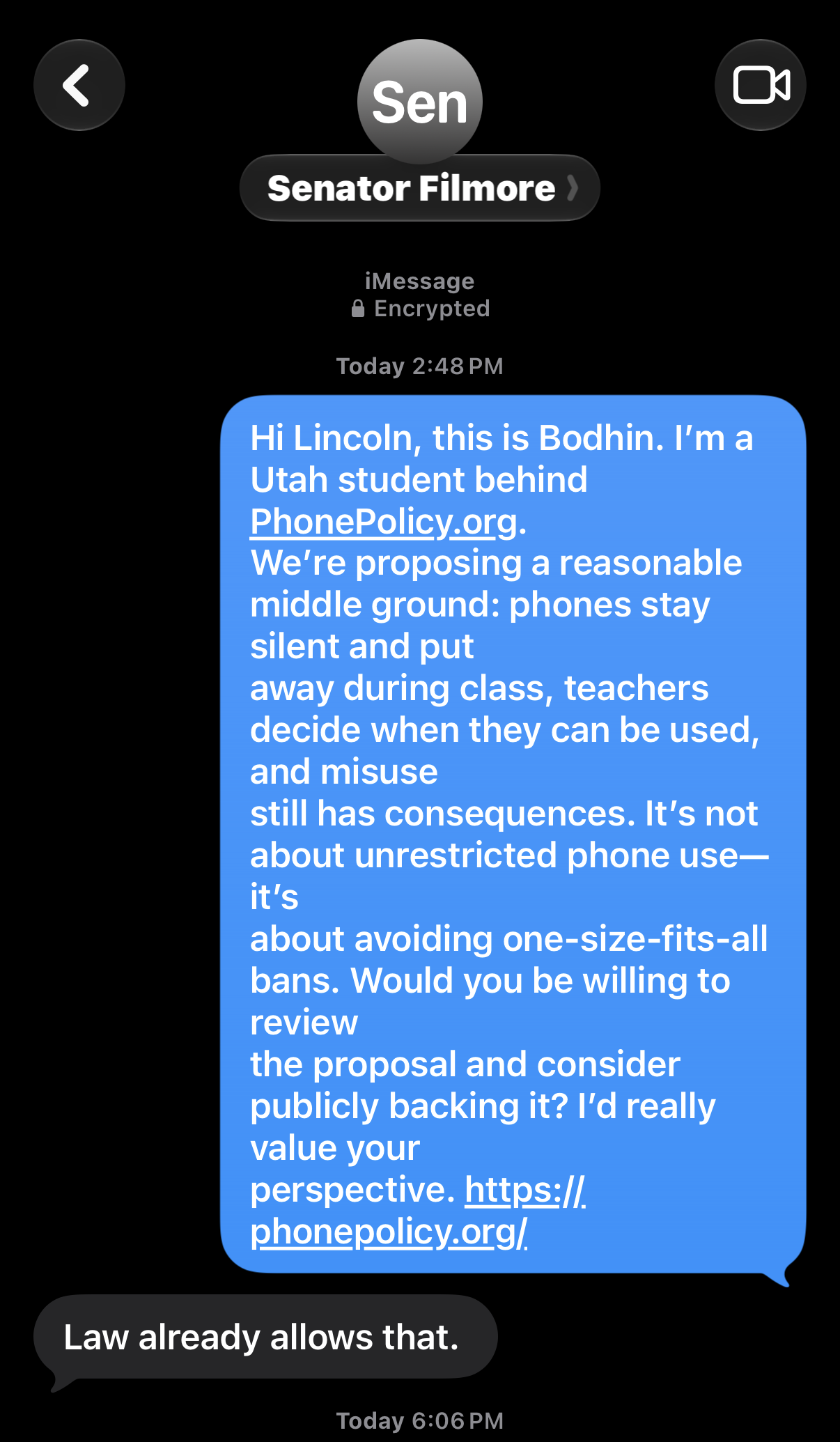
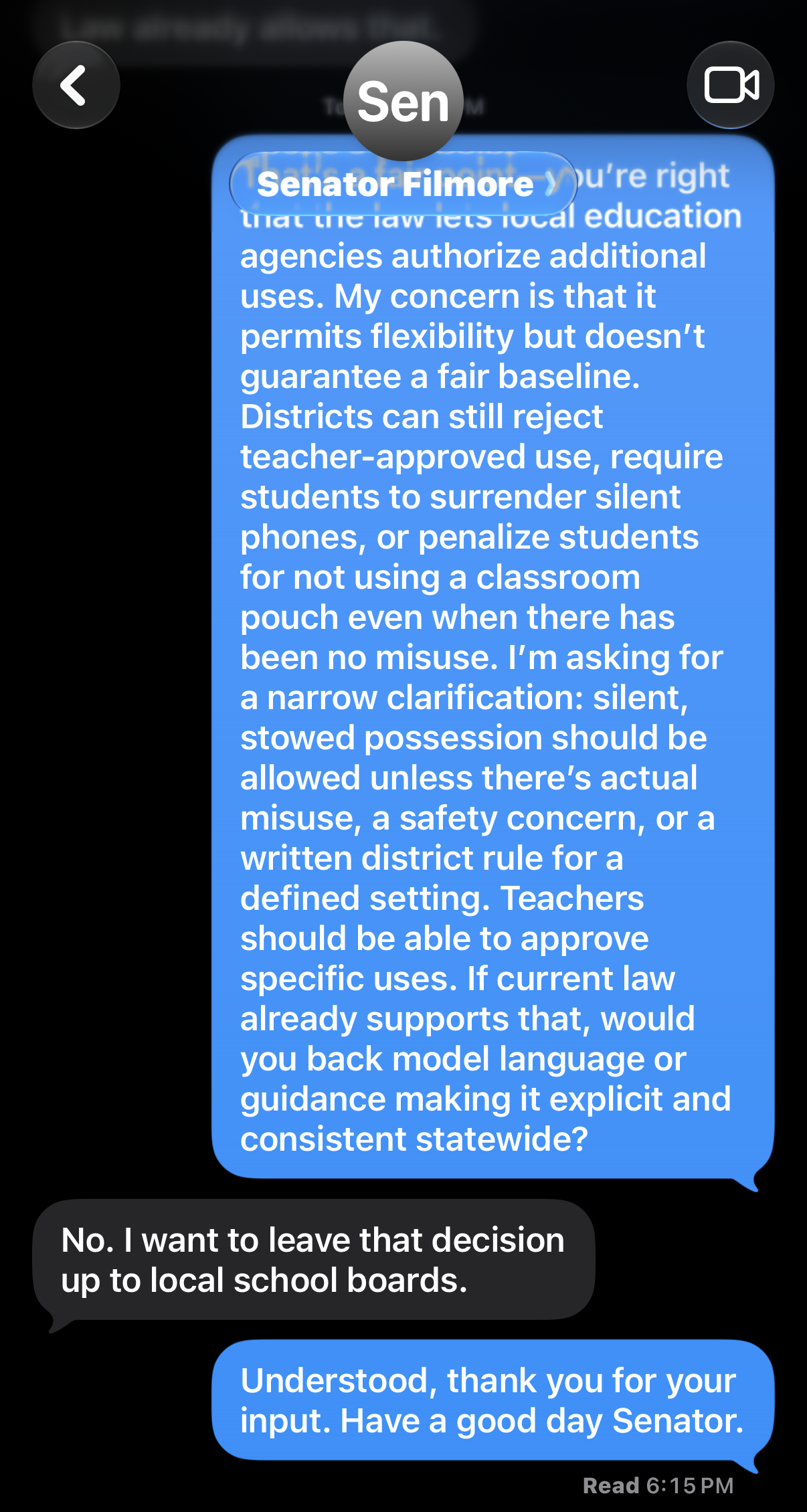
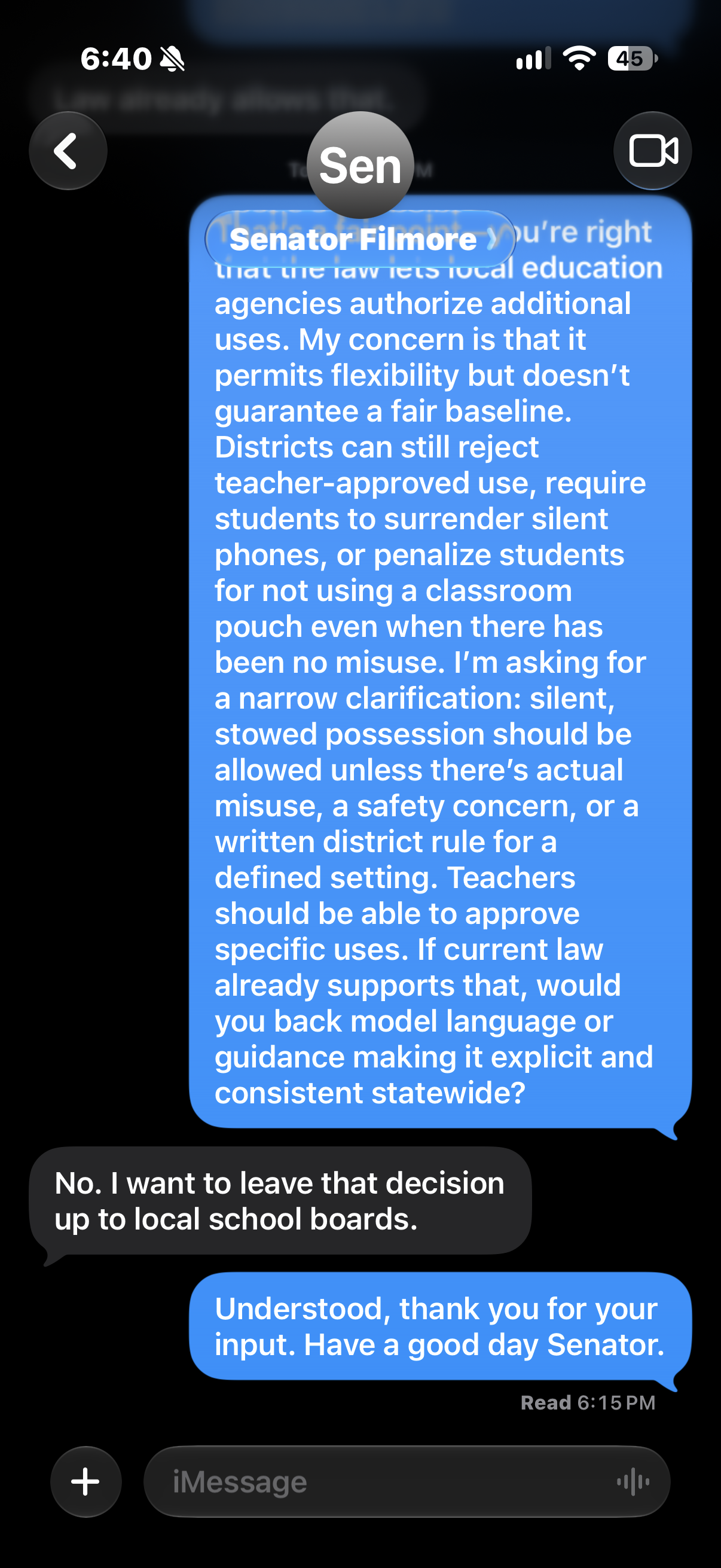
Full-frame screenshots. Only hidden file metadata was removed; the visible pixels are unchanged.
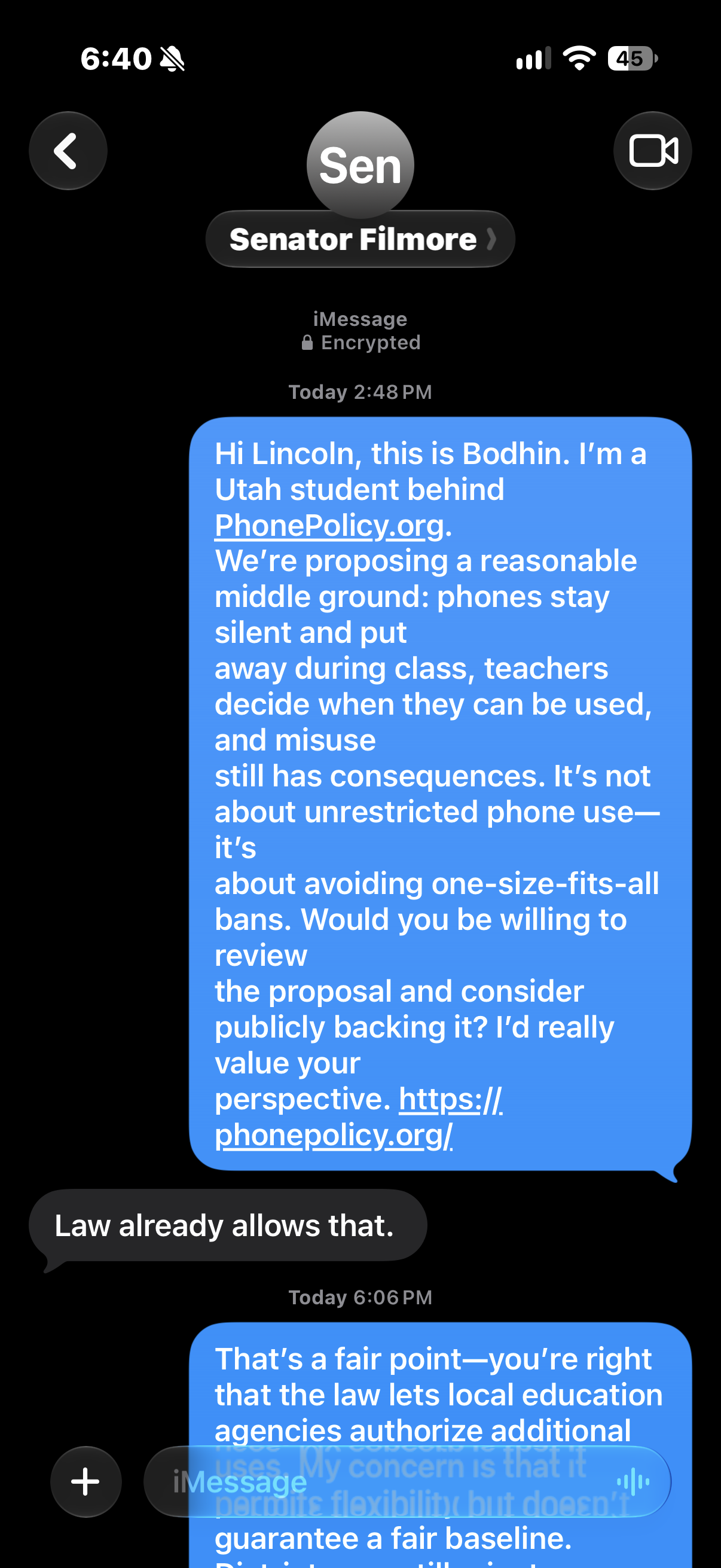
Hi Lincoln, this is Bodhin. I’m a Utah student behind PhonePolicy.org. We’re proposing a reasonable middle ground: phones stay silent and put away during class, teachers decide when they can be used, and misuse still has consequences. It’s not about unrestricted phone use—it’s about avoiding one-size-fits-all bans. Would you be willing to review the proposal and consider publicly backing it? I’d really value your perspective. https://phonepolicy.org/.
Law already allows that.
That’s a fair point—you’re right that the law lets local education agencies authorize additional uses. My concern is that it permits flexibility but doesn’t guarantee a fair baseline. Districts can still reject teacher-approved use, require students to surrender silent phones, or penalize students for not using a classroom pouch even when there has been no misuse. I’m asking for a narrow clarification: silent, stowed possession should be allowed unless there’s actual misuse, a safety concern, or a written district rule for a defined setting. Teachers should be able to approve specific uses. If current law already supports that, would you back model language or guidance making it explicit and consistent statewide?
No. I want to leave that decision up to local school boards.
Understood, thank you for your input. Have a good day Senator.
Read 6:15 PM
Tell Utah lawmakers and local school leaders: keep phones put away during class, but do not treat a silent device as a disruption.
We ask Utah leaders to:
Students should be trusted to follow a clear rule—and held accountable when they do not.
RECORDED SUPPORT ENTRIES
Checking the live count…At 1,000 eligible recorded support entries, PhonePolicy.org will prepare an aggregate-only support-entry summary and policy packet for Utah lawmakers, the Utah State Board of Education, and relevant local boards. The petition stays open.
The exact total, privacy-safe grouped counts, the model Carry + Permission policy, the research summary, and a proposed pilot scorecard.
No names, last initials, raw comments, signature hashes, or exact timestamps leave petition administration. Small groups are hidden or combined so the report cannot point back to one person.
This is not a Utah statutory initiative, referendum, ballot petition, or certified signature submission. Reaching 1,000 does not, by itself, require a hearing, vote, endorsement, or policy change. It gives officials a clear, documented request to consider.
Want the details? Read the petition privacy notice.
Twenty-two printable signs. Some are board-meeting calm. Some say the quiet part out loud.
Open the printable sign pack ↗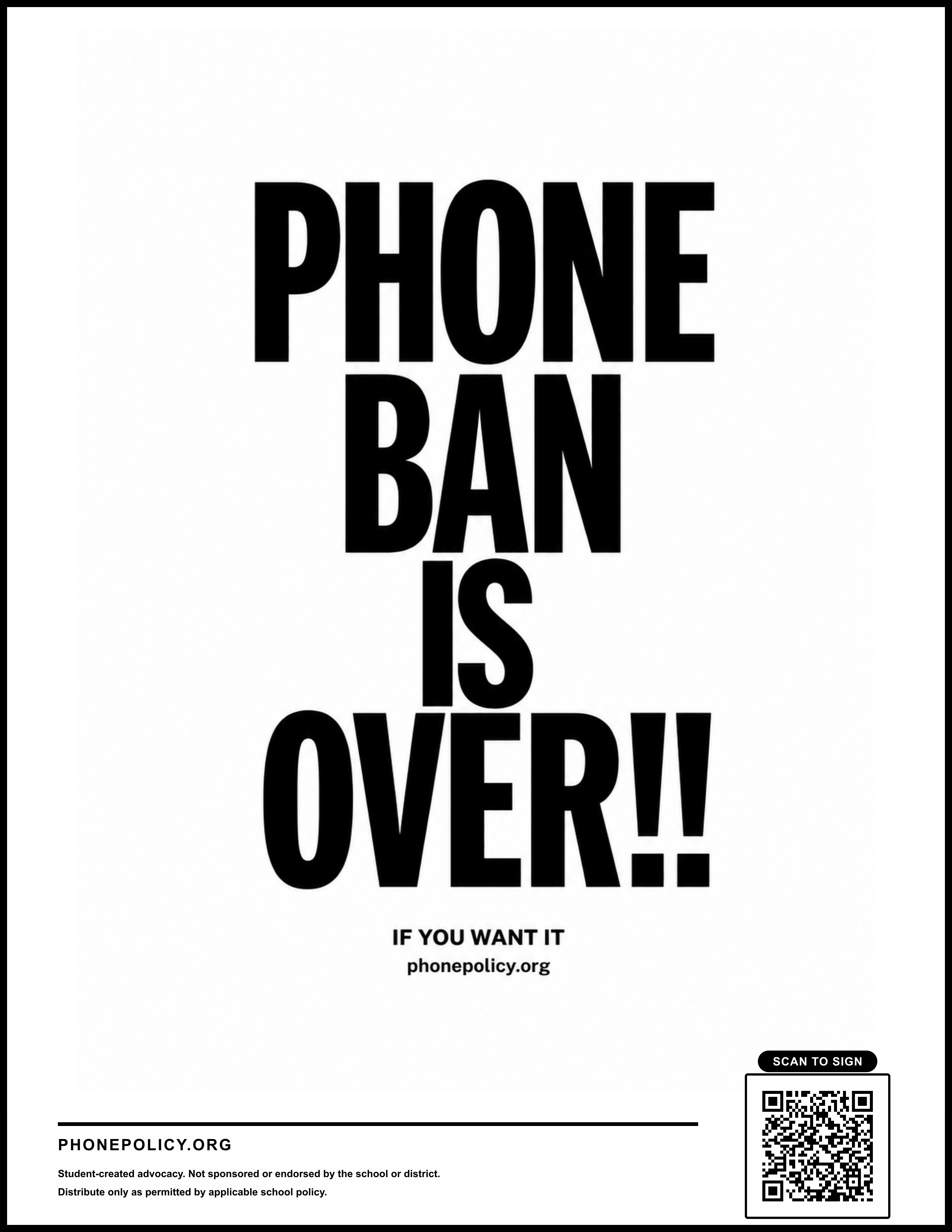
Public-school students have First Amendment rights. Schools can still enforce lawful, viewpoint-neutral rules about disruption and the time, place, and manner of distributing materials. But a school should not target a viewpoint simply because it is unpopular.
If you think a school is trying to silence your viewpoint, stay calm. Ask for the written policy and a written reason. Save dates, messages, and copies of the material. Involve a parent, guardian, or another trusted adult before escalating.
Read FIRE's overview of student speech rights, limits, and major court cases.
ACLU of Utah accepts civil-rights help requests, but it does not promise representation or emergency help.
Request help from ACLU of Utah ↗IFS accepts requests involving speech, publishing, assembly, and petition rights. Sending the form does not create an attorney-client relationship.
Contact the Institute for Free Speech ↗FIRE, ACLU of Utah, and the Institute for Free Speech have not endorsed PhonePolicy.org and cannot promise help. This page is general information, not legal advice.
Utah's process calls for input from students, parents, educators, and community members. Sign the petition, then ask your district or charter board to put this proposal on an agenda.
Search your district or charter site for “personal electronic device policy.” Mark where local discretion is already used.
Invite a student, parent, educator, and accessibility advocate if you can. A mixed group shows how the policy affects different people.
Request the Carry + Permission language, a one-semester pilot, baseline data, and a date to review the results.
ONE-MINUTE BOARD COMMENT
“Good evening. My name is [name], and I am a [role] in [community]. I am asking the board to adopt the Carry + Permission Standard…”
A MESSAGE TO SHARE
Keep it with you. Put it away in class. Use it with permission. #PhonePolicy
Invite students, parents, educators, and accessibility advocates. Check the model language, ask 15–25 Utahns what is unclear, and do not claim endorsements you do not have.
Publish the petition, a short video, the evidence page, and the board comment together. Aim for 1,000 eligible recorded support entries across 15 local education agencies.
Give public comment, meet with legislators, ask USBE for a permission-first model policy, and invite an educator and disability advocate to help shape the proposal.
Ask one district or charter school to try the rule for a semester, track baseline data, and set a date to review the results.
Here is how the proposal handles classroom control, emergencies, misuse, and access.
No. The default during instruction is simple: silent, put away, and out of sight. Under our proposal, and only where the LEA’s written policy authorizes it, a teacher can approve a specific use and end it at any time.
No. Under the proposed policy, teachers control permitted classroom use. Administrators should handle repeated problems, and no teacher has to include personal devices in a lesson.
Utah now prohibits student use bell-to-bell by default, but the law lets local education agencies define additional permitted uses. Making permission-first a guaranteed statewide option would require a change to the statute.
No. State law does not require one storage method statewide. Utah’s current education rule requires local possession-and-use policies and says violating an LEA or teacher instructional policy may lead to temporary confiscation. Our proposal asks boards to adopt a narrower, clearer standard built around on-person storage and documented reasons.
Not under our proposed rule. A silent, concealed device would not be misconduct by itself. Staff could temporarily hold it after the device is seen out or used against policy, refusal to put it away, a specific safety or privacy concern, or when a written district or charter-board rule applies. A documented individualized plan following repeated misuse could also require time-limited storage. Students still need to follow their current school policy while we work to change it.
Not under our proposal. A present student should not be marked absent, tardy, unprepared, or non-participating solely for declining an optional phone holder. A restroom request alone would not justify taking a silent, concealed device. Mandatory storage would need a written board-approved rule or a documented individualized restriction following repeated misuse. A specific immediate safety or privacy concern could justify a temporary hold, not a standing rule.
The same rule applies: put them away during instruction unless a teacher approves them or an accommodation requires them. No audio in labs or other safety-sensitive settings unless staff allow it.
Current law already protects use during imminent threats and schoolwide emergencies, as well as SafeUT, IEP or 504, and medically necessary use. This proposal keeps those protections and supports clear emergency plans that do not depend on one device.
First, give a quiet reminder and require the device to be put away for the rest of class. If a temporary hold is needed, state and document the reason and return time. Repeated misuse can lead to parent contact, an individual plan, or time-limited administrative storage. Serious conduct still follows normal discipline rules.
Nothing. This proposal does not require students to own a device. Any device-based activity must also have a school-provided or non-device option, consistent with Utah’s rule.
We oppose making a tracked digital system the only way to use the restroom. Under this proposal, every student gets a private, non-digital hall-pass option; restroom access cannot depend on a personal device or continuous location tracking. A school may still offer a limited digital option if it minimizes data, limits access, publishes a deletion schedule, and provides an equal offline alternative.
Academic grades should measure demonstrated learning. Attendance and tardiness may be recorded and reported separately, but should not raise or lower an academic grade by themselves. A narrow written exception may apply when a stated standard can only be assessed through labs, performances, clinicals, or supervised practice, with a reasonable make-up or alternative demonstration when appropriate.
READY TO BACK THE PLAN?